
When you have an immediate health issue, you have two main choices: go to the urgent care or go to the emergency room. It might seem like they’re one and the same, but this choice could be the difference between a minor inconvenience and a massive financial headache. It’s important to understand the differences between urgent care vs. emergency care in Nevada to choose the right one.
10 Differences in Urgent Care vs. Emergency Care in Nevada
No, urgent care and emergency care aren’t the same thing. For more non-life-threatening issues, choosing an urgent care is almost always the best choice for both your schedule and your wallet. But to help you make the best choice in a stressful scenario, here are the top 10 differences between urgent care vs. emergency care in Nevada.
1. Cost Efficiency
Most things in the healthcare world ultimately come down to money. And in the battle between urgent care vs. emergency care, the choice is simple:
Urgent care is significantly cheaper than emergency care.
For the same minor injury, an ER visit can cost five to ten times more than an urgent care clinic.
Nevada Cost Comparison (2026 Averages)
| Service Category | Urgent Care Visit | Emergency Room (ER) Visit |
| Self-Pay (No Insurance) | $100 – $300 | $1,200 – $3,000+ |
| Insurance Copay | $20 – $75 | $150 – $500+ |
| Average Wait Time | 15 – 45 Minutes | 2 – 4+ Hours |
| Facility Fees | Minimal to None | $500 – $1,000+ |
2. Wait Times
When you have an immediate medical emergency, that’s no time to sit around in a waiting room. You want to be seen quickly to resolve the problem.
Emergency rooms operate on “triage,” which means the most life-threatening cases go first. If you have something more minor, like the flu, you may see wait times upwards of 4 hours!
Urgent care clinics, on the other hand, generally use a “first come, first served” system. They’ll usually see patients in as little as 45 minutes.
3. Facility Fees
There are a lot of fees in the healthcare industry. And one of them is the facility fee. This is one major difference between urgent care vs. emergency care in Nevada.
ERs are part of a hospital system and charge “facility fees” just for walking through the door. You might even see $500-$1,000 added to your bill before you even see a doctor.
While you may see facility fees added to your urgent care bill, they will be significantly lower than going to an emergency room.
4. Billing Transparency
Many urgent care facilities offer “flat-rate” pricing for self-pay patients — no hidden surprises. It’s more transparent and shows exactly what you’re paying for.
ER billing, on the other hand, is notoriously complex and difficult to predict. It’s hard to gauge what a visit to the emergency room will cost, even for minor issues.
5. Specialization vs. General Care
Emergency rooms are designed for trauma, heart attacks, and strokes — more severe, potentially life-threatening conditions. Urgent care facilities are more set up for general care.
Going to the ER for a sore throat, for example, uses up critical resources meant for life-saving interventions. However, visiting an urgent care for a heart attack isn’t the best option, since they aren’t as prepared for trauma events.
6. Accessibility
There are only a few hospitals but dozens of urgent care locations throughout Las Vegas, Reno, and Henderson. Urgent care centers are often closer to residential neighborhoods compared to major hospitals — especially in rural areas. In a time-sensitive healthcare situation, finding the closest facility may be the best choice when it comes to choosing urgent care vs. emergency care in Nevada.
7. Procedure Costs
It’s expensive to run a hospital. And when you visit an ER, you’re going to be charged a markup for the hospital overhead. Urgent care facilities don’t have the same overhead, helping to minimize overall procedure costs.
A simple X-ray or blood test performed at an urgent care in Nevada is billed at a standard rate, while the same test in an ER often costs significantly more.
8. Insurance Acceptance
While both urgent cares and emergency rooms accept most insurance plans, the copays are not the same. For example, most Nevada insurance plans, including those on the Silver State Health Insurance Exchange, have urgent care copays between $20-$75, while ER copays will run around $150-$500+ depending on the services.
9. Follow-up Simplicity
Have you ever tried calling a hospital? Getting through the menus to find the department or person you’re looking for can be a nightmare. Urgent care facilities are typically better with communication — including with your primary care physician. It’s much easier to manage your recovery through an urgent care without the bureaucracy of a hospital system.
10. Convenient Hours
Most emergency rooms are open 24/7, which can be a benefit for those experiencing serious, immediate health concerns during “off hours.” However, many urgent care facilities are open late on weekdays and throughout the weekends, which provides the same “after-hours” benefit as the ER — but without the emergency-level price tag.
Urgent Care vs. Emergency Care in Nevada: When Should You Choose Which?
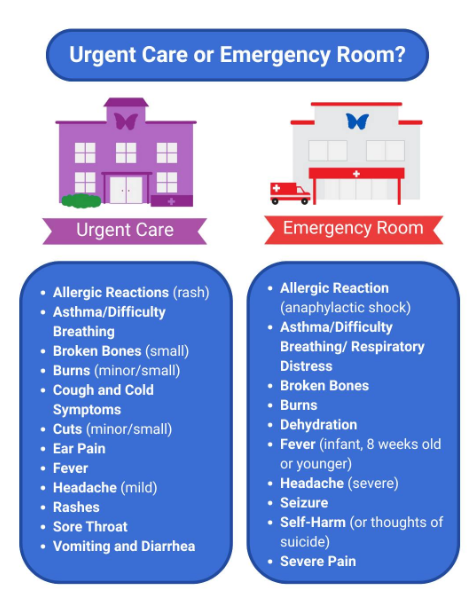
In most cases, you can save a lot of time, money, and headaches going to an urgent care. However, it’s not the best option for every scenario. The choice between urgent care vs. emergency care in Nevada typically comes down to the severity of the condition:
- Go to Urgent Care for: minor fractures, sprains, cuts needing stitches, fevers, flu, earaches, and UTIs.
- Go to the ER for: chest pain, difficulty breathing, symptoms of stroke (slurred speech, numbness), severe head injuries, or uncontrolled breathing.
Looking for health insurance that’ll work for your visit to either the urgent care or emergency room? Contact us at Health Benefits Associates. Our team of local agents understand the Nevada healthcare landscape and will walk you through the options to find the plan that works for your unique needs. Schedule an appointment by calling 775-828-1216 today.